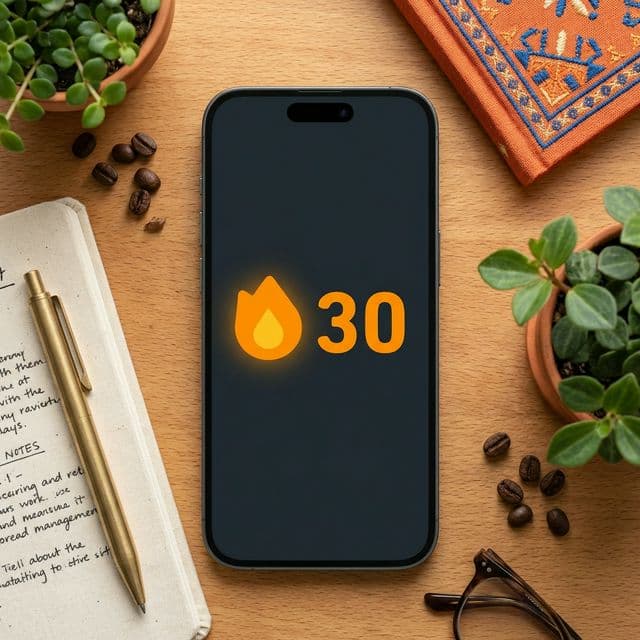
Ask any reader who has maintained a long streak why they kept going, and the answer is almost always the same: “I just didn’t want to break it.” That feeling — the reluctance to reset a number you’ve worked to build — isn’t weakness. It’s one of the most reliable motivational mechanisms in habit psychology, and it’s exactly why streaks work.
The “Don’t Break the Chain” Effect
The concept became famous through a story about Jerry Seinfeld. His system for writing comedy was brutally simple: write every day, mark an X on a wall calendar for each day you write, and never break the chain of Xs. As the chain grows, it becomes its own motivation — not because of the goal, but because of the streak itself.
Reading streaks work on exactly the same principle. Once you have a five-day streak, you find a few minutes to read on day six not because you’re particularly inspired, but because five days of momentum is too valuable to throw away. The chain does the heavy lifting so your motivation doesn’t have to.
This is especially powerful in the first few weeks of a habit, when motivation naturally fluctuates. The streak gives you a reason to show up even on days when you don’t feel like it — which is exactly when habits are made or broken.
Loss Aversion: Why Streaks Feel So Hard to Give Up
Behavioural economics has a well-documented principle called loss aversion: people feel the pain of losing something roughly twice as intensely as the pleasure of gaining the same thing. In other words, losing a 14-day reading streak hurts about twice as much as gaining a 14-day streak feels good.
This asymmetry is what makes streaks so sticky. Once your streak number starts climbing, the prospect of resetting it starts to feel genuinely costly. You’d rather find ten minutes to read before bed than watch a three-week streak disappear.
Apps like Duolingo have famously capitalised on this for language learning, and the mechanism is just as effective for reading. The longer your streak, the stronger the pull to maintain it.
Consistency Beats Volume Every Time
Streaks push you toward consistency, and consistency is ultimately what determines how much you read over the course of a year. Most people intuitively assume the opposite — that the key is reading a lot on the days when you have time, and that the occasional long session makes up for the days you skip.
The math says otherwise. Ten pages a day, every day, is 3,650 pages a year — roughly ten novels. Someone who reads 100 pages on Saturday and then skips the rest of the week is reading at the same pace, but the daily reader will have built a deeply ingrained habit, while the weekend reader is still relying on motivation.
Streaks enforce the discipline of showing up daily. Even five pages on a hard day keeps the chain alive and the habit intact.
Streaks and Identity: “I Am a Reader”
In his book Atomic Habits, James Clear makes a compelling case that the most durable habits are those tied to identity, not outcomes. The difference between “I’m trying to read more” and “I’m a reader” is the difference between a goal and a character trait.
Reading streaks accelerate this identity shift. Every day you keep the streak going is a vote for the identity “I am someone who reads every day.” After 30 consecutive days, that identity starts to feel genuinely true. After 100 days, it’s just part of who you are.
This is why long streaks become self-sustaining. It’s not willpower anymore — it’s identity. And identity is a far more stable foundation for a habit than motivation, which comes and goes.
Milestones Make the Journey Visible
One limitation of a plain streak counter is that it just keeps climbing — a number without narrative. Milestones solve this by dividing the streak into meaningful chapters. Reaching 7 days is a genuine achievement. 30 days is something most people have never done. 100 days is a genuine transformation.
ReadBrew celebrates streak milestones at 3, 7, 14, 21, 30, 60, and 100 days — each with its own moment of recognition. These aren’t just cosmetic. Each milestone is a psychological checkpoint that reinforces the habit and gives your brain a reward for the behaviour you’re building.
How Not to Use Streaks
Streaks are a powerful tool, but they can backfire if you use them wrong. A few things to watch out for:
Don’t let the streak override the reading
If you’re reading one page at midnight just to preserve the streak, you’ve let the metric become the goal. Streaks are there to support your reading, not replace it. If a one-page session is the best you can do tonight, that’s completely fine — but make sure the reading itself remains the point.
Missing one day isn’t a failure
Research on habit formation consistently shows that missing one day has almost no effect on long-term outcomes. What matters is the response to missing. If you treat a broken streak as a catastrophe, you’re more likely to give up entirely. If you treat it as a minor reset and start a new streak the next day, the habit survives.
The rule to live by: never miss twice in a row. One day is an exception. Two days is the beginning of a new pattern.
Don’t chase the streak at the cost of enjoyment
If maintaining your streak is making reading feel like a chore, recalibrate. Lower your daily minimum. Give yourself permission to read slowly. The point of a reading streak is to make reading a joyful, consistent part of your life — not to create anxiety around it.
The Bottom Line
Reading streaks work because they harness real psychological mechanisms — loss aversion, the power of momentum, and identity formation — to keep you showing up daily. They don’t require extraordinary motivation. They just require showing up, every day, for a number that’s becoming harder and harder to abandon.
Start your streak today. Even five pages counts. And see how it feels at day seven.
Start your reading streak today
ReadBrew tracks your streak automatically and celebrates every milestone — 3, 7, 14, 30, 60, and 100 days.
Free to download · No account required